




MagicMenu
Our approach
Who it's for
  • Senior living
  • Skilled nursing
  • Camps & retreats
  • Distributors & partners
TechnologyEconomics
Sign inStart a conversationTalk to us
MagicMenu
  • Our approach
  • Who it's for
    • Senior living
    • Skilled nursing
    • Camps & retreats
    • Distributors & partners
  • Technology
  • Economics
  • Our story
  • Investors
Sign in
Start a conversation

Personalized meals, at scale.

Supercharge your hospitality while improving your margins.

Accommodate every dietary need while streamlining your kitchen. MagicMenu connects individual needs and your chef's menu with real supplier products and practical kitchen and service plans.

Start a conversation
A server sets a dessert in front of a smiling guest at a long table while the people around him talk.

Dietary needs are here to stay.

Allergies. Health needs. Personal preferences.
Different needs are an everyday part of sharing a meal.

  • Illustrative concept: A blonde woman in a cream top, holding a hand-lettered sign: Celiac.

    Celiac

  • Illustrative concept: A dark-haired woman in a sage top, holding a hand-lettered sign: Vegetarian.

    Vegetarian

  • Illustrative concept: A dark-haired man in a cream top, holding a hand-lettered sign: Gluten-free and dairy-free.

    Gluten-free · Dairy-free

  • Illustrative concept: A silver-haired woman in a lavender cardigan, holding a hand-lettered sign: Dysphagia and renal diet.

    Dysphagia · Renal diet

More than half of adults follow a particular way of eating.

57%↗ in 2025, up from 36%↗ in 2018.1

But meeting every need, at every meal, is hard.

“I can’t risk cross-contact.”

Illustrative concept: The same blonde guest worried about her meal, with a paper lunch bag.

Food
allergies

95%↗

of allergy-affected diners have avoided a restaurant because its allergen information wasn't clear.

In Nutritics’ June 2026 survey of 1,000 U.S. adults whose dining decisions were influenced by allergies or intolerances, 95% had avoided a restaurant at least occasionally because clear allergen information was difficult to find. Respondents included people accommodating their own needs or those of dining companions.↗

Nutritics 2026 Allergy Dining Report ↗
33 million↗

Approximately 33 million people in the United States have at least one food allergy.

FARE estimates that approximately 33 million Americans have at least one food allergy. This is a U.S. population estimate, not a count of guests at any one kitchen, and is distinct from celiac disease and food intolerance.↗

FARE, Facts and Statistics ↗


“Why am I still being served chicken?”
Illustrative concept: The same vegetarian guest disappointed with a chicken plate.

Dietary
preferences

57%↗

of U.S. adults followed a specific diet or eating pattern in the past year.

IFIC’s 2025 survey found that 57% of adults ages 18–80 had followed a specific diet or eating pattern during the previous year. This includes many approaches, such as high-protein, vegetarian, and gluten-free eating; it does not mean 57% avoid meat or require a medical diet.↗

IFIC 2025 Food & Health Survey ↗
33%↗

of U.S. adults said in 2018 they wouldn't go back if staff ignored their preferences.

SevenRooms commissioned YouGov to survey 1,108 U.S. adults online on April 3–4, 2018, with results weighted to represent U.S. adults aged 18 and older. One-third said they would not revisit a restaurant if they felt their server had ignored their preferences. This measures stated intentions about preferences broadly, not vegetarian diners specifically, and is a historical 2018 finding rather than a current prevalence estimate.↗

SevenRooms / YouGov, Turning a Meal into an Experience (2018) ↗
“This bun tastes like cardboard.”
Illustrative concept: The same man holding a dry bun above a sparse, plain meal.

Dietary
intolerances

36%↗

of adults who live with or know someone with a food allergy, intolerance or sensitivity rank eating out among their top three worries.

IFIC surveyed 1,000 U.S. adults in January 2025. Among respondents with a food allergy, intolerance or sensitivity in their household, or who knew someone affected outside it, 36% placed eating at a restaurant among their three leading concerns. This is a combined dietary-needs group, not an intolerance-only statistic or a percentage of all U.S. adults. The report identifies dairy as the most frequently mentioned intolerance and sensitivity among affected households.↗

IFIC Spotlight Survey: Food Allergens, Intolerances & Sensitivities (2025), pp. 10 and 13 ↗
61%↗

of diners with allergies or intolerances have stayed home because finding a safe restaurant felt like too much work.

In Nutritics’ June 2026 survey of 1,000 U.S. adults whose dining decisions were influenced by allergies or intolerances, 61% said they had chosen to eat at home because finding a safe restaurant felt like too much work. Respondents included people accommodating their own needs or those of dining companions. This is a combined allergy-and-intolerance finding, not a gluten-free-only or dairy-free-only statistic.↗

Nutritics 2026 Allergy Dining Report ↗
“I can’t swallow this.”
Illustrative concept: The same older guest with eyes closed, clutching her throat with both hands.

Swallowing
difficulties

≈47%↗

of older nursing-home residents are estimated to have trouble swallowing.

A systematic review and meta-analysis estimated dysphagia—difficulty swallowing—in 46.98% of older nursing-home residents across the included studies. Results varied substantially by study and assessment method. This pooled international estimate is not a U.S.-only prevalence figure.↗

Prevalence and Methods for Assessment of Oropharyngeal Dysphagia in Older Adults, 2022 ↗
5,923↗

people died from choking in the U.S. in 2024.

National Safety Council analysis reports 5,923 choking deaths in 2024, with death rates rising rapidly from about age 71. The total includes choking on food and other objects across all ages; it is not a count specifically of dysphagia-related deaths or deaths in care facilities.↗

National Safety Council, Injury Facts ↗

Each dietary need adds complexity to ingredients, preparation, and service—putting more pressure on already busy kitchens. For the person at the table, a missed detail can mean feeling unseen, being left out, or, in the most serious cases, a trip to the hospital.

Now, you can meet every need.Simply.And save money.

“I don’t have to bring my own food. They’ve thought of me!”
“Seitan! They remembered what I love.”
“Gluten-free, dairy-free—and made just for me. I feel so cared for.”
“Prepared with such care. I can relax and enjoy my meal.”

People feel the difference when their needs are remembered. A familiar meal, thoughtfully adapted. A place at the table, with the care and attention they deserve.

A paid design partnership uses MagicMenu’s technology to adapt your menu and validate savings. Then keep the technology for a small monthly fee, plus transaction fees only on agreed value events. How pricing works →

The meal you imagined.
Fewer versions to prepare.

MagicMenu finds what can be shared and what needs its own preparation—keeping the character of your menu while simplifying the work.

“What makes MagicMenu compelling is that it isn't trying to replace culinary judgment. It gives chefs and operators a safer, clearer system for executing that judgment at scale.”
— Hillary Greeneformer VP Operations, Birdcall · Culinary Institute of America valedictorian · MagicMenu advisor
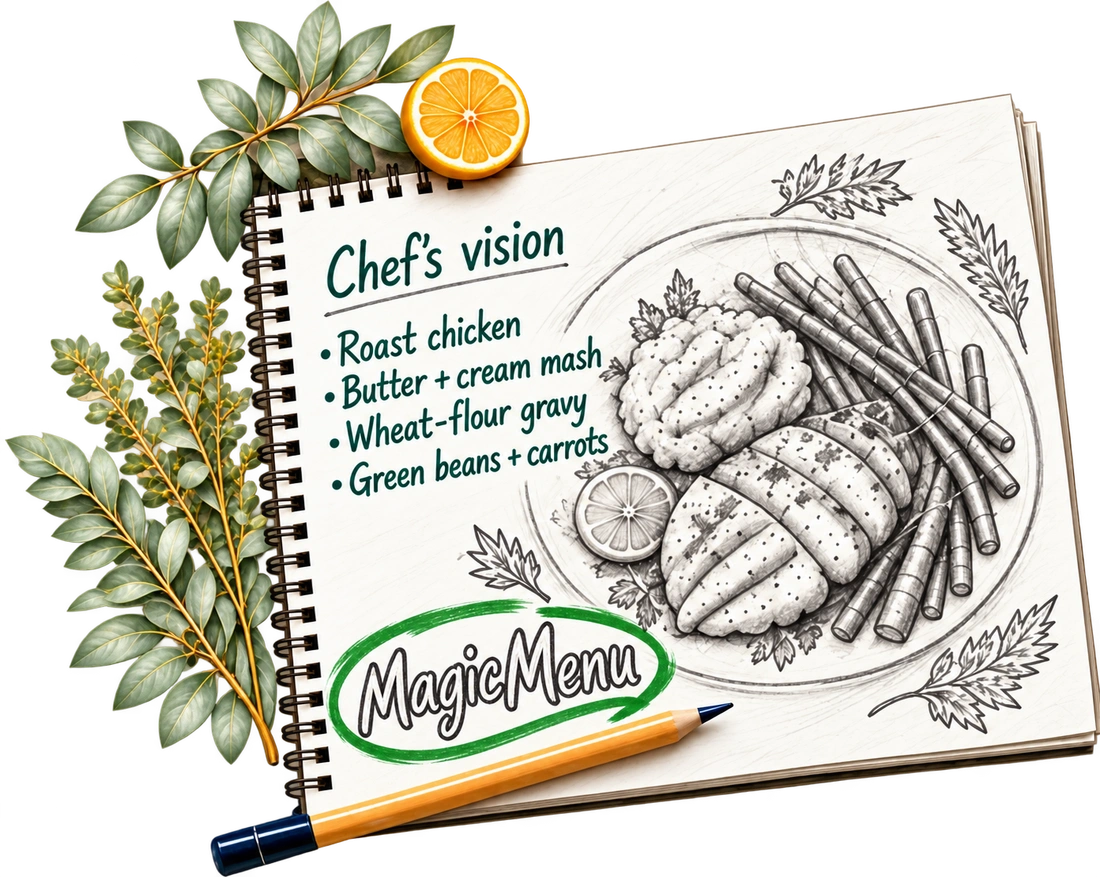
Chef’s vision: roast chicken, mash, gravy, green beans and carrots.
Several versions. Extra prep. One shared set of sides. Shared across plates.

An illustrative menu: butter-and-cream mash and dairy-free mash become one shared mash. Traditional, gluten-free, and vegetarian gravies become one shared gravy. Buttered and dairy-free vegetables become one shared vegetable preparation.

Butter-and-cream
mash
Dairy-free
mash
✓

Mash, two waysOne creamy mash

A separate batch for each need.All the comfort. One shared recipe.

What changes +

A dairy-free, plant-based recipe keeps the creamy mash at the heart of the meal. The same base can accompany both proteins.

Traditional gravy Gluten-free gravy Vegetarian gravy
✓

Gravy, three waysOne rich gravy

Three recipes to keep track of.Full of flavor. Made to share.

What changes +

A vegetable-based stock and gluten-free thickener bring these three preparations together in one rich, plant-based gravy.

Buttered
vegetables
Dairy-free
vegetables
✓

Vegetables, two waysOne colorful side

One more pan. One more step.The same color, care, and character.

What changes +

A dairy-free finish lets both plates share the vegetables. The chef’s choice of vegetables and seasonings remains central.

Two proteins.
Texture adapted where needed.1

The shared preparations come together in each plate.

Celiac
GF · DF

Roast chicken

The chef’s original inspiration.

Shared mash · gravy · vegetables
Vegetarian

Plant roast

A different protein. The same care.

Shared mash · gravy · vegetables
Dysphagia · Renal diet

Texture adapted

Extra preparation where it matters.

Shared components · adapted texture

Explore the recipes, products and preparation details →

More people enjoying your menu.
Fewer separate dishes to make.

How we work with you.

Three steps, together. We connect your guests’ dietary needs, your menu, and the way your kitchen works, from the first conversation through daily service.

  1. 1

    Understand your people & kitchen

    Together, we review dietary needs, menus, supplier invoices, and how your kitchen works.

    Illustrative concept: A chef in a black apron reviews a menu with a MagicMenu representative in a green branded apron.
  2. 2

    Make your menu work for everyone

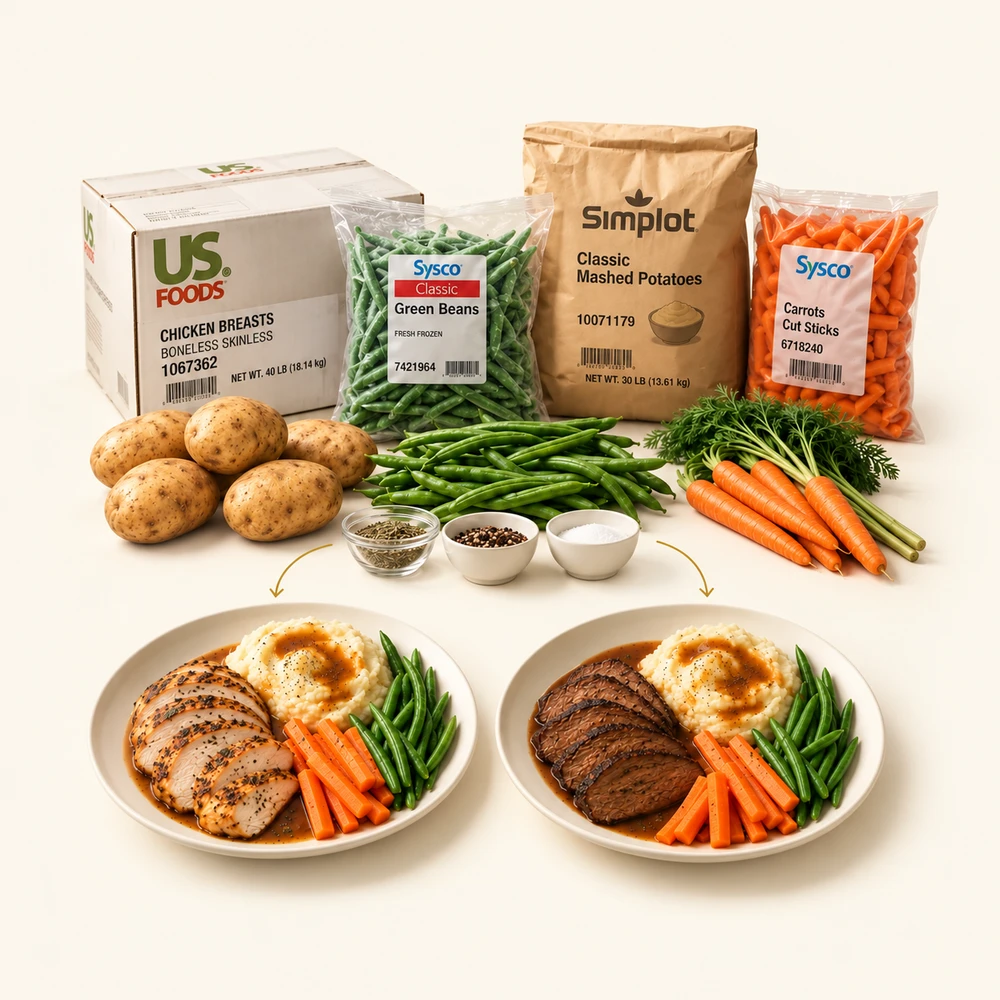
    We adapt recipes, optimize production variants and match supplier products, preserving what makes your menu special.

    Illustrative concept: Supplier products and fresh ingredients connected to chicken and plant-based dinners.
  3. 3

    Put the plan into practice

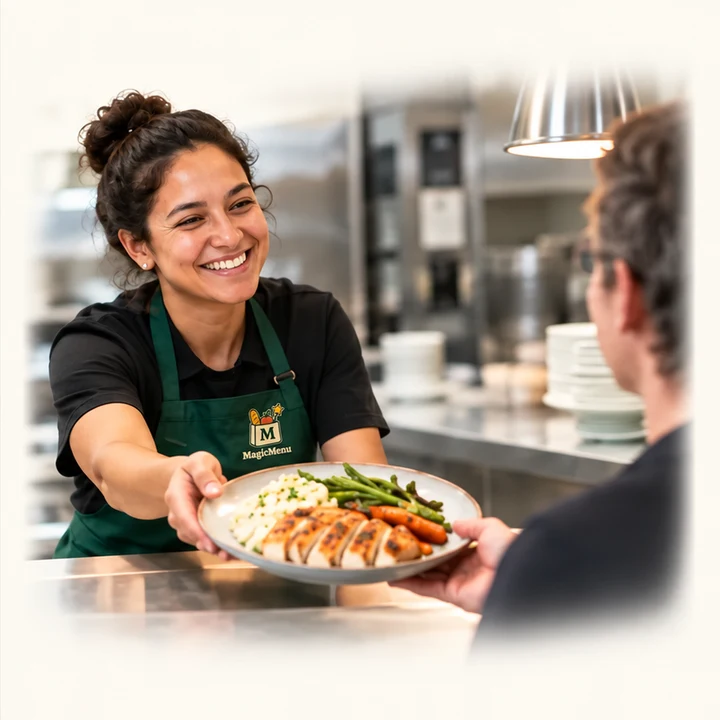
    We work with your crew on purchasing, production and service — making the approved plan repeatable, all the way to the plate.

    Illustrative concept: A smiling team member serves a prepared meal to a guest.

Better meals. Better margins.

Meeting complex dietary needs can lower the cost of service. MagicMenu connects menu planning, purchasing, and prep to reduce overbuying, food waste, remakes, and last-minute store runs.

Dollars saved

Food purchases · Waste · Emergency buys

Staff time recovered

Planning · Prep · Rework

“For operators, the value is obvious: fewer manual cross-checks, cleaner substitutions, better purchasing, and a kitchen team that can focus on execution instead of firefighting.”
— Hillary Greeneformer VP Operations, Birdcall · Culinary Institute of America valedictorian · MagicMenu advisor
See where the savings come from →

Running in real kitchens.

Annunciation Heights

In service

Retreat week · Aug 2026

120 guests. Every allergy plate.

→

Senior living is next.

Become our partner →

Real voices.

“I've never felt this accommodated in my entire life.”
— Lizguest at the Encounter retreat · August 2026
“This GF/DF lasagna is the best lasagna I've had in my life.”
— Sarahguest at Encounter retreat · Aug 2–8, 2026
“MagicMenu will help cooks from making mistakes.”
— Chef Spencer HardenExecutive Chef, 30+ years, Marriott · culinary consultant to MagicMenu

The people behind MagicMenu.

Dusty Dequine, founder of MagicMenu.

Dusty Dequine

Founder

MIT-trained aerospace engineer. Experience at Boeing, Lockheed and Apple. Built MagicMenu from the kitchen outward.

Denis Washio

Denis Washio

Founding Software Architect

Founding engineer at ReadyOn and AI architect at AE Studio. Builds MagicMenu’s core platform, data architecture and production infrastructure.

Raeceph RJ Sayson

Raeceph “RJ” Sayson

Founding AI / ML Engineer

More than eight years in Python engineering and applied machine learning. Builds AI systems for menu planning, dietary constraints, costs and food procurement.

Strategic advisors

Gary HawkinsGary HawkinsIndustry partnerships & go-to-market

Author of Bionic Retail and a longtime retail-technology advisor. Helps shape partner strategy and open grocery, CPG and foodservice conversations.

Hillary GreeneHillary GreeneMulti-unit restaurant operations

Restaurant operations experience at Birdcall, Anheuser-Busch and Hillstone, with Cornell and Culinary Institute of America training. Tests plans against kitchen realities and helps establish distributor contacts.

Edith Clogg, RDEdith Clogg, RDClinical dietetics & skilled nursing

Registered dietitian and former nutrition-strategy leader at Guckenheimer/ISS. Leads dietetics review and helps build a validation dataset for allergy and diet workflows.

Devon SampsonDevon SampsonData science & architecture

Ph.D. data scientist and former VSCO data-science leader, with UN FAO research experience. Guides ingredient-data architecture, evaluation design and evidence for product claims.

Meet the team and explore the investor view →

Bring us one kitchen challenge.

Thirty minutes with Dusty. Bring your dining director — and your RD if you can.

Start a conversationSchedule a conversationDistributor or partner? Let's talk →
MagicMenu

Complex needs.
Simpler kitchens.

dusty@magicmenu.ai

Explore

  • Our approach
  • Who it's for
  • Examples
  • Technology
  • Sources

Your setting

  • Camps & retreats
  • Senior living
  • Skilled nursing
  • Distributors & partners
  • Reunions & group trips

More

  • Our story & team
  • Savings
  • Investors
  • Press
  • Contact

MagicMenu provides operational and informational support, not clinical, medical, or nutritional advice. Allergen-screened menus are built from ingredient screens against currently available product data; unknown data never passes a plate. They are subject to verification, and to the operator's own cross-contact controls, which reduce but cannot eliminate risk. Final ingredient, service, and guest-safety decisions rest with the operator. Guest information is handled under written agreements and appropriate privacy safeguards.

Illustrative people, food and kitchen images are concepts. Actual photographs and product outputs are identified in their captions.

Schedule a conversation

© 2026 MagicMenu, Inc. · Denver, ColoradoPrivacyTerms

1 Illustrative dining experiences: feeling remembered, included and cared for. Illustrative menu plan. Exact ingredients, cross-contact controls and any texture adaptation require review for the individual and kitchen.